
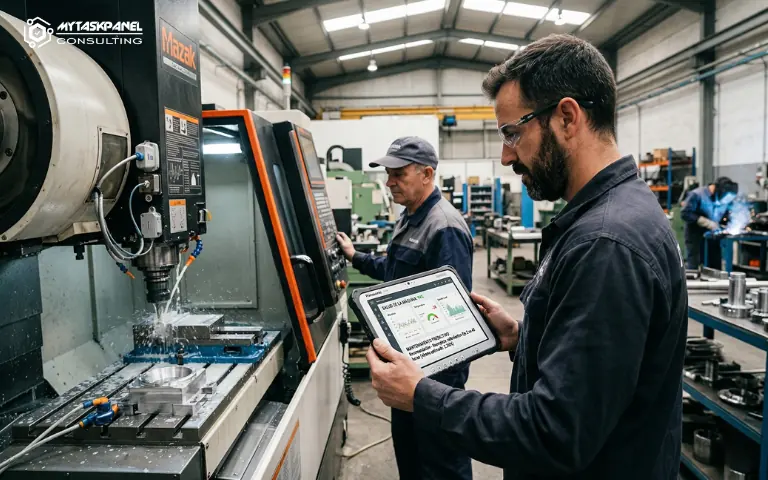
In many industrial SMEs, profitability depends on a factor as simple as it is decisive: machines working when they are supposed to work. Yet unexpected breakdowns, downtime, and poorly planned maintenance remain some of the biggest sources of financial loss.
This is where predictive maintenance with AI becomes a true strategic lever for industrial SMEs. We are not talking about futuristic mega-investments or fully robotized factories. We are talking about using data and artificial intelligence to anticipate failures, optimize resources, and protect margins.
The difference between a company that reacts to problems and one that anticipates them may define its competitiveness in the years ahead.
What is predictive maintenance with AI in industrial SMEs?
Traditionally, industrial companies have worked with two maintenance models:
- Corrective maintenance: action is taken when the machine fails.
- Preventive maintenance: periodic inspections are performed even when there are no signs of failure.
The problem with corrective maintenance is obvious: unexpected downtime, delays, urgent costs, and operational stress. Preventive maintenance improves the situation but is not always efficient: parts are replaced before necessary, and unnecessary inspections are performed.
Predictive maintenance with AI introduces a third model: acting when data indicates a high probability of failure.
How does it work from a business perspective?
- Operational data is collected (temperature, vibration, energy consumption, usage cycles, etc.).
- AI analyzes historical patterns.
- Anomalous behaviors are detected.
- Alerts are generated before failures occur.
The goal is not to inspect by calendar, but to intervene at the optimal moment.
Why is predictive maintenance key to profitability?
In an industrial SME, a single critical stoppage can cause:
- Missed deadlines.
- Contractual penalties.
- Loss of customer trust.
- Urgent repair costs.
- Unplanned overtime.
- Direct margin impact.
Predictive maintenance with AI significantly reduces these risks.
Direct impact on results
The most common benefits include:
- Reduction of unplanned downtime.
- Lower maintenance costs.
- Longer asset lifespan.
- Improved production planning.
- Optimized spare parts inventory.
For an SME, this can translate into a substantial improvement in financial stability.
How to apply predictive maintenance with AI in an industrial SME?
One of the biggest myths is that this technology is only accessible to large corporations. The reality is that scalable and affordable solutions exist today.
Step 1: identify critical assets
Not all machines require the same level of monitoring. The first step is to identify:
- Equipment whose downtime directly impacts production.
- Machinery with high repair costs.
- Assets with a frequent breakdown history.
Start with what truly affects the business.
Step 2: data collection
Many SMEs already generate data without using it. Others can incorporate basic sensors to measure:
- Vibrations.
- Temperature.
- Energy consumption.
- Pressure.
- Operating time.
The goal is not to install complex systems, but to obtain relevant information.
Step 3: AI-based analysis
This is where the differentiating component comes in. AI analyzes historical and real-time data to:
- Detect anomalous patterns.
- Identify correlations invisible to manual analysis.
- Predict failure probabilities.
The system does not replace the maintenance manager; it provides early insights for better decision-making.
Step 4: integration into operational management
The key is not only to predict, but to act. The system must integrate with internal processes to:
- Generate automatic alerts.
- Schedule interventions.
- Coordinate teams.
- Adjust production planning.
Without integration, prediction loses its value.
Practical example in an industrial SME
Imagine a metal manufacturing company with three critical cutting machines.
Current situation:
- 3–4 unexpected stoppages per year.
- Average cost per stoppage: €8,000.
- Impact on deadlines and penalties.
With AI-based predictive maintenance:
- Vibrations and temperature are monitored.
- AI detects progressive anomalies in a motor.
- Intervention is scheduled during a low-load period.
- Total breakdown is avoided.
Result:
- Fewer critical stoppages.
- Better planning.
- Less operational stress.
- Significant annual savings.
These cases are no longer theoretical; they are increasingly common.
Competitive advantages for industrial SMEs
Predictive maintenance does more than reduce costs. It creates strategic advantages:
- Greater reliability for customers: consistently meeting deadlines improves reputation and opens new business opportunities.
- Better financial planning: fewer surprises mean more predictable costs.
- More efficient use of capital: avoids premature investments in new machinery due to poorly managed wear.
- Operational professionalization: the company evolves toward data-driven management rather than intuition.
Risks and common mistakes
Like any technological transformation, there are risks that management must address:
- Automating without strategy.
- Failing to involve the maintenance team.
- Focusing only on immediate savings instead of long-term stability and reputation.
Key indicators to measure success
To assess the impact of predictive maintenance with AI, management should track:
- Reduction in unplanned downtime.
- Average maintenance cost.
- Mean Time Between Failures (MTBF).
- On-time delivery performance.
- Return on Investment (ROI).
Technology must translate into concrete metrics.
The strategic role of leadership
Predictive maintenance is not just a technical project; it is a strategic decision. Leadership must:
- Define vision and priorities.
- Allocate budget intelligently.
- Start with measurable pilot projects.
- Scale progressively.
SMEs that lead this transition will not only reduce costs but also be better prepared to compete in an increasingly demanding industrial environment.
Conclusion: anticipation is the new competitive advantage
In small industry, the difference between protecting or losing margins often depends on operational stability. Predictive maintenance with AI enables companies to shift from reaction to anticipation. This is not about adopting technology because it is trendy, but about using it to protect the business, improve efficiency, and strengthen competitiveness.
At MyTaskPanel Consulting, we help industrial SMEs identify critical assets, design predictive maintenance strategies, and implement AI solutions tailored to their reality.
If you want to reduce critical downtime, optimize costs, and transform your industrial management through data and AI, now is the time to start. Anticipation is no longer optional—it is strategic.


