
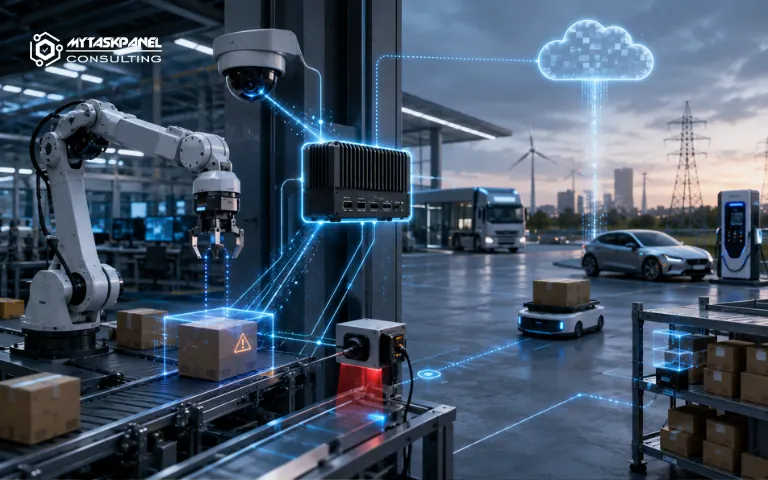
For years, digital transformation has relied on a clear model: data is generated on devices, sent to the cloud, processed, and a response is returned. This approach has worked well for many applications, but it is beginning to show its limits when decision speed becomes critical.
In industries such as manufacturing, logistics, retail, energy, and mobility, waiting seconds — or even milliseconds — can lead to financial losses, operational risks, or poor customer experiences.
This is where AI-powered edge computing marks a turning point. It is not just about processing data faster, but about automating decisions in real time, exactly where events occur. For organizations, this opens a new stage in automation: systems that don’t just inform, but act instantly.
What is AI-powered Edge Computing and why does it change the rules?
Edge computing consists of processing data close to where it is generated (sensors, machines, cameras, devices), instead of sending it to distant data centers.
When artificial intelligence is added to this approach, the result is a system capable of:
- Analyzing information in real time.
- Making decisions automatically.
- Executing actions without relying on the cloud.
- Reducing latency to a minimum.
AI-powered edge computing turns devices into intelligent decision points. This is not an incremental improvement — it is a shift in the operational model.
The limits of the traditional cloud model
The cloud model has been fundamental for digitalization, but it presents limitations when immediacy is required:
- Dependence on connectivity.
- Latency in sending and receiving data.
- Network saturation from large volumes of information.
- Availability risks.
In processes where every second counts, this model creates friction.
AI-powered edge computing removes this dependency by allowing decisions to happen locally.
What does this mean for business automation?
Until now, many automations have been reactive:
Data is generated → sent to a central system → analyzed → a decision is made → an action is executed.
With AI-powered edge computing, this cycle becomes:
Data → Analysis → Immediate action
This enables truly real-time automation, with no waiting and no intermediaries.
Real examples of AI-powered Edge Computing
Industry and manufacturing
Sensors in machinery detect abnormal vibrations. AI embedded in the device decides to stop the machine before a critical failure occurs. No cloud transmission. No delay. Instant action.
Logistics and warehousing
AI-enabled cameras identify packaging errors the moment they occur and automatically stop the line, preventing the error from propagating through the chain.
Physical retail
Vision systems detect in-store customer behavior patterns and adjust digital signage or promotions in real time.
Energy and utilities
Smart devices adjust energy consumption or distribution based on patterns detected instantly.
Mobility and transportation
Onboard systems analyze environmental conditions and make decisions without depending on constant connectivity.
Strategic benefits of AI-powered Edge Computing
- Decision speed: latency is practically eliminated; decisions happen in milliseconds.
- Operational continuity: systems function even without internet connectivity.
- Reduced data transmission costs: no need to send massive volumes of data to the cloud.
- Greater security and privacy: sensitive data can be processed locally without leaving the device.
- True automation: systems don’t just report — they act.
Why this matters for executives?
AI-powered edge computing is not a technology trend. It is a direct response to a business problem: the need to react faster than competitors.
It enables organizations to:
- Reduce operational losses.
- Improve service quality.
- Automatically optimize resources.
- Minimize risks.
- Create differentiated experiences.
In a competitive environment, the ability to act in real time becomes a strategic advantage.
Where does it make the most sense to start?
Not every area requires edge computing. It is essential to identify processes where:
- Latency has economic impact.
- Devices are constantly generating data.
- Immediate decisions provide clear value.
- Dependence on connectivity is a risk.
These points are usually found in operations, not administration.
Challenges to consider
Adopting AI-powered edge computing also brings challenges that must be managed:
- Integration with existing systems: local decisions must synchronize with central systems.
- AI model governance: distributed models must be maintained and updated.
- Device security: increased intelligence at the edge increases the risk surface.
- Change management: teams must trust systems that act automatically.
How to successfully approach an AI-powered Edge Computing project?
An effective approach usually follows these steps:
- Identify critical processes where immediacy is essential.
- Define clear, measurable use cases.
- Design controlled pilots.
- Integrate the solution with central systems.
- Scale progressively.
The goal is not to deploy technology, but to solve a specific problem with direct impact.
The role of MyTaskPanel Consulting
At MyTaskPanel Consulting, we help organizations identify where AI-powered edge computing can generate the greatest impact and how to integrate it into their technological ecosystem.
Our approach focuses on:
- Real use cases with clear return on investment.
- Integration with existing processes.
- Real-time automations that deliver operational value.
- Sustainable and secure architecture design.
This is not about installing smart devices, but about building automations that act when they are needed most.
Conclusion: automation can no longer wait
The next evolution of automation is not about making processes faster, but about making them instantaneous. AI-powered edge computing allows companies to move from reacting to anticipating, from analyzing to acting, and from depending on the cloud to having distributed intelligence.
In an environment where every second counts, the ability to make decisions in real time is a defining advantage. If you want to explore how to take your organization’s automation to the next level with real-time decision-making, now is the time to start thinking about AI-powered edge computing.


