
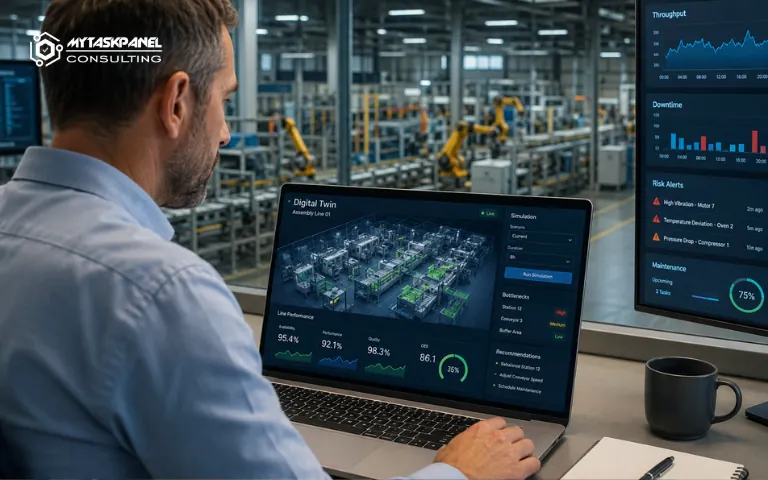
AI-powered Digital Twins are changing the way companies manage complex operations.
A Digital Twin is a virtual representation of a real process, asset or system. It makes it possible to observe what is happening, simulate scenarios and make better decisions before applying changes to the physical operation.
In sectors such as logistics, energy or industry, where a small deviation can generate significant costs, this technology helps companies anticipate problems, reduce errors and optimize resources.
What is a Digital Twin?
A Digital Twin is a digital replica of a physical system.
It can represent, for example:
- A warehouse.
- A vehicle fleet.
- An energy plant.
- An industrial line.
- An electrical grid.
- A critical asset.
Its value lies in the fact that it is fed by real data: sensors, ERP systems, IoT systems, logistics platforms, maintenance tools or internal databases.
Unlike a traditional dashboard, it does not simply display information. It also allows companies to simulate scenarios and answer questions such as:
- Which area will become saturated first?
- Which asset is underperforming?
- Which route consumes the most resources?
- What would happen if demand increased?
This allows the company to make decisions with a more complete view.
Why combine it with AI?
A Digital Twin provides visibility. But artificial intelligence makes it possible to go one step further.
With AI, the system can:
- Detect patterns.
- Identify anomalies.
- Predict deviations.
- Recommend actions.
- Anticipate risks.
Without AI, the digital twin shows what is happening. With AI, it helps understand why it is happening and what may happen next.
If automation is also added, some responses can be triggered automatically: sending alerts, creating tasks, updating reports, logging incidents or recalculating routes.
Example in logistics: optimizing a warehouse
A logistics company may have a large amount of data, but spread across different systems: ERP, warehouse software, spreadsheets, scanning devices and transport platforms. The problem is usually that this information is not always connected.
A Digital Twin of the warehouse would make it possible to visualize:
- Goods coming in and going out.
- Stock levels.
- Workload by area.
- Dock status.
- Preparation times.
With AI, the system could detect saturated areas, orders at risk of delay, unnecessary routes during picking or mismatches between capacity and demand. From there, the company could simulate changes before applying them: reorganizing products, modifying shifts or redistributing workload between areas.
The value lies in testing decisions without interrupting the real operation.
Automation applied to logistics
When the Digital Twin detects a deviation, automation makes it possible to turn that information into action.
For example:
- If an area is about to become saturated, it sends an alert.
- If a critical order may be delayed, it creates a priority task.
- If a route will not arrive on time, it suggests an alternative.
- If a bottleneck appears, it generates a report for management.
This way, the digital twin stops being only an analysis tool and becomes an operational management tool.
Example in energy: anticipating deviations
In energy, Digital Twins are useful for managing complex assets: solar plants, wind farms, electrical grids, storage systems or facilities with high energy consumption.
A digital twin can integrate data from sensors, SCADA systems, maintenance, weather, energy production and demand. In a solar plant, for example, it can compare expected production with actual production and detect efficiency losses.
With AI, the system could identify:
- Underperforming inverters.
- Anomalous consumption.
- Production deviations.
- Assets that require inspection.
- Energy-saving opportunities.
This makes it possible to act before a deviation becomes a larger incident.
Digital Twins and renewable energy
The integration of renewable energy is one of the major challenges in the energy sector. Solar and wind production depend on variable factors such as weather, wind, radiation or demand peaks.
A Digital Twin makes it possible to simulate scenarios before making important decisions:
- What happens if demand increases.
- How a new solar plant would affect the grid.
- What storage capacity would be needed.
- Where bottlenecks could appear.
These simulations reduce risks and help plan investments more effectively.
How to get started?
It is not necessary to create a digital twin of the entire company from day one. The best approach is to start with a specific process:
- A warehouse.
- A fleet.
- An energy facility.
- An industrial line.
- A critical asset.
Before developing the solution, it is worth answering three questions:
1. What do we want to optimize?
Delays, energy efficiency, maintenance, costs or waiting times.
2. What data do we have available?
ERP, sensors, WMS, SCADA, IoT, spreadsheets or internal historical data.
3. What decisions do we want to improve?
The goal is not to visualize data, but to make better decisions.
From there, a first functional version can be created and progressively evolved.
From visibility to action
AI-powered Digital Twins make it possible to observe, simulate and optimize complex operations. In logistics, they help improve warehouses, routes, inventory and operational capacity. In energy, they support asset control, anomaly detection and renewable energy integration. But their real value appears when they are connected to the company’s real processes and allow teams to move from analysis to action.
At MyTaskPanel Consulting, we help companies develop intelligent solutions connected to their operations: automation, system integration, data analysis, custom software and AI applied to real processes.
Do you want to explore how a Digital Twin could help you optimize logistics, energy or industrial operations? We analyze your processes, available data and objectives to design a scalable solution adapted to your business.
'/%3E%3C/svg%3E)
'/%3E%3Cpath%20fill='%23b2b2b2'%20d='M241%20382q0%2016%2017%2026%2017%2011%2042%2011t42-11q16-11%2017-26V269H241'/%3E%3Cpath%20fill='%239f7e00'%20d='M241%20379q0%2014%208%2023%209%209%2021%209%2014%200%2021-9%209-9%209-23V269h-59'/%3E%3Cpath%20d='M241%20339v-70h59v110q0%2014-9%2023l-6%205v-68h-15v72q-8%200-14-4v-68zm59%2040c0%2022%2015%2032%2029%2032%2021%200%2030-18%2030-32v-40h-59'/%3E%3Cpath%20fill='%239f7e00'%20d='M266%20277v5h2v12h-3v-5h2v-5h-9v5h2v5h-4v9h3v18h-5v10h34v-10h-5v-18h3v-9h-4v-5h2v-5h-9v5h2v5h-3v-12h2v-5zm42%20101q0%2010%206%2017%206%206%2015%207%2010-1%2016-7%206-7%206-17v-29h-43'/%3E%3Ccircle%20fill='%230044ad'%20cx='329.5'%20cy='372'%20r='6'/%3E%3Cellipse%20fill='%230044ad'%20cx='300'%20cy='340'%20rx='16'%20ry='21'/%3E%3C/svg%3E)
