
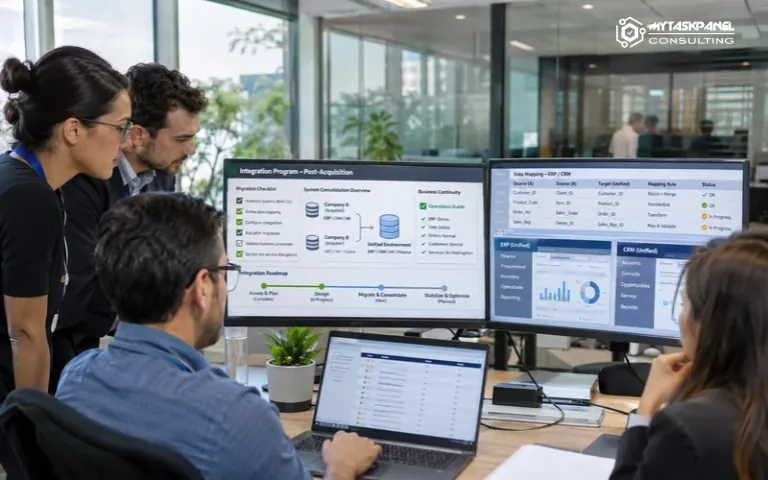
Acquiring another company can create opportunities for growth, access to new markets, and increased operational capabilities. However, it also presents a challenge that does not always receive enough attention: integrating two different technology environments.
Duplicate systems, incompatible databases, different vendors, and disconnected processes can make it difficult to operate as a unified organization. A well-planned technology integration strategy enables companies to move toward greater efficiency without putting existing services at risk.
Why is technology integration a challenge after an acquisition?
When two companies begin working together, they need to coordinate more than just teams and processes. They must also decide how their systems will interact. It is common for each organization to use its own ERP, CRM, HR tools, sales platforms, and internal applications. In some cases, the technologies are compatible. In others, they use different data structures, require specific integrations, or have contractual conditions that make replacement difficult.
This can lead to duplication, manual tasks, and difficulties obtaining consolidated information. For example, management may need to analyze sales across the newly combined group but find that the two companies use different sales systems that calculate performance indicators differently. Technology integration must address these challenges without disrupting day-to-day operations.
The first step: understanding existing systems
Before deciding which platforms to retain or replace, it is essential to conduct a technology inventory. This review should identify the applications in use, their functions, the departments responsible for them, vendors, costs, and dependencies.
It is also important to determine which systems are critical to business continuity. Replacing a collaboration tool does not have the same impact as modifying a system responsible for invoicing, production, or order management. This analysis helps identify duplicate tools, underused applications, and systems that require special attention.
It also makes it easier to detect risks related to access permissions, maintenance, documentation, or knowledge concentrated in specific individuals.
Which systems should be integrated and which should be retained?
One of the most common mistakes after an acquisition is assuming that all systems must be unified immediately.
Technology integration does not always require replacing existing tools. In some cases, keeping two platforms connected through integrations may be more efficient than carrying out a complete migration. In others, duplication creates high costs, inconsistencies, and operational difficulties that justify consolidating systems.
The decision should consider several factors:
- The system’s importance to business operations.
- Maintenance and licensing costs.
- The quality and security of the solution.
- User requirements.
- Compatibility with other tools.
- Migration risks.
- The ability to support the company’s future strategy.
The goal is to establish a technology environment that works for the newly combined organization.
Data integration: one of the most critical challenges
Even when two companies use similar tools, their data may be organized differently. One system may identify customers using an internal code, while another uses a tax identification number. Different categories may also exist for products, services, or sales statuses.
If this data is combined without a prior review, duplicates, errors, and reporting problems can arise. For this reason, technology integration must address data quality, mapping rules between systems, and the definition of reliable data sources.
It is important to decide which data should be migrated, which can remain in its original platforms, and what information needs to be available to both organizations. An incorrect migration can affect invoicing, orders, contracts, and customer relationships.
How to maintain business continuity?
An acquisition should not require business operations to stop while technology systems are reorganized. To avoid this, it is advisable to plan a gradual transition. The most critical processes should have backup mechanisms, prior testing, and recovery procedures in place in case something goes wrong.
It is also useful to establish periods during which both systems operate in parallel. During this stage, old and new tools can work together until the necessary validations have been completed.
Another essential consideration is choosing the right time to implement changes. Migrating sales data during a financial closing period or modifying logistics systems in the middle of a sales campaign can unnecessarily increase risk. Planning must take actual business operations into account, not just the availability of the technical team.
Security, access permissions, and vendors
Integration requires reviewing who can access which information. After an acquisition, there may be different security policies, duplicate users, outdated accounts, or external vendors with permissions that are no longer appropriate. It is necessary to assign responsibilities, review credentials, and establish consistent access policies.
Technology contracts, licenses, cloud services, and maintenance agreements should also be reviewed. Not all tools can be automatically transferred or extended to a new business entity. Identifying these conditions early helps prevent contractual issues and unexpected expenses.
The role of CTO as a Service
Company leadership may need to make numerous technology decisions without having an in-house CTO. In this context, a CTO as a Service can provide leadership and technical expertise throughout the integration process.
The role involves coordinating the assessment, defining priorities, evaluating risks, and developing a technology roadmap aligned with the acquisition’s objectives. It can also facilitate collaboration between vendors, technical teams, and business leaders.
This broader perspective is essential to avoid isolated decisions, such as unnecessary migrations, duplicate tools, or investments that do not deliver value to the newly combined organization.
How to measure integration success?
Management should establish performance indicators from the beginning. Some of the most useful include reducing duplicate costs, decreasing manual tasks, ensuring system availability, and shortening the time required to obtain consolidated information.
It is also advisable to track incidents during the transition and monitor progress against defined milestones. These indicators help determine whether the integration is delivering the expected improvements without compromising business operations.
Technology integration after an acquisition requires coordinating systems, data, and teams without putting business continuity at risk.
At MyTaskPanel Consulting, we offer CTO as a Service to help companies assess their technology architecture, prioritize decisions, and plan their technological evolution. Is your company integrating another business or reorganizing its systems? Contact us, and we’ll help you define a realistic technology strategy.