
Your software is already live. Keep it moving forward. We take care of what comes next.
We take responsibility for the applications your business relies on every day. We resolve issues, deliver improvements and maintain stability so they can keep evolving, even if another team built them.
Business keeps running.
Day-to-day operations continue while we work on new improvements.
We deliver what you need.
Example: new integration
We assess how to add the integration without disrupting the system.
You don't have to wait until something breaks.
When an application becomes essential to your business, keeping it up to date demands ongoing attention. Here are some situations where having a team responsible for it makes a real difference.
We handle urgent issues without losing sight of what matters.
An incident should not keep bringing product improvements to a halt. We organize urgent fixes and planned work so both can move forward.
- We assess incidents based on their business impact.
- We separate urgent work from planned improvements.
- We keep priorities, progress and outstanding work visible.
You do not have to wait for a major problem. You need a team that understands your application, anticipates potential issues and can support its continued evolution.
We keep what works running. We make what comes next possible.
An application needs attention on two fronts: remaining reliable today while adapting to what the business will need tomorrow. Our service covers both.
Keep everything running smoothly.
We look after the technical health of your application and address issues that could disrupt day-to-day operations.
Issue resolution and bug fixes
We investigate and fix errors that affect the everyday use of your application.
Security and updates
We review dependencies, apply updates, and address technical risks.
Stability and performance
We investigate recurring failures, response times, and signs of performance degradation.
While we look after what is already in place, we continue adding new capabilities.
Help it do more over time.
We add features and improvements so the product continues to meet real business needs.
New features
We extend the product to support new processes, needs, and opportunities.
Integrations and automation
We connect systems, enable data exchange, and reduce manual work.
User experience
We improve interfaces, user journeys, and workflows to make everyday work easier.
It is a way of supporting the product throughout its lifecycle: addressing issues, preventing future problems, and building improvements that create value.
Peace of mind does not come from never having issues. It comes from knowing there is a team that understands your application, can resolve issues, and has the capacity to keep improving it.
Hours alone don’t determine priorities. The impact on your business does.
Not every task has the same urgency. We organize the work around its impact, the risks involved, and real business needs. When something unexpected happens, we revisit the plan with you.

One application. Two different situations.
What we address first
ILLUSTRATIVE EXAMPLE-
01
Security Assess a detected vulnerabilityAssess risk
-
02
Evolution Integration for the sales teamPlanned
-
03
Bug fix Non-blocking issue with searchNext cycle
-
04
Optimization Improve loading times in non-critical areasSchedule
Priorities should never be improvised. Every change to the plan must have a clear rationale and a known impact.
We don't need to have built it. We need to understand it to take care of it.
Is your previous provider no longer available? Has your technical team changed? Is the documentation incomplete? We can assess how to take over without proposing to rebuild your application from scratch.
Select what you already have.
You don't need to have everything ready to start a conversation. This helps us identify what needs clarifying first.
We would start by locating the source code.
Identifying where the source code is stored and which version is currently in use is essential before we can assess how to maintain the application.
- What components and dependencies the application uses.
- Which risks and issues need attention.
- How to make changes safely and what the first actions should be.
We do need to identify essential access and knowledge before making changes to a live system.
Changing providers shouldn't mean starting over. Our goal is to rebuild the necessary context so we can keep what already works running and continue improving it.
Your software shouldn't depend on one person. Or on us.
As an application evolves, so should the knowledge behind it. We document how it works, how to maintain it, and why key decisions were made.
Knowledge should be accessible. Not buried in conversations, emails, or a single developer’s memory.
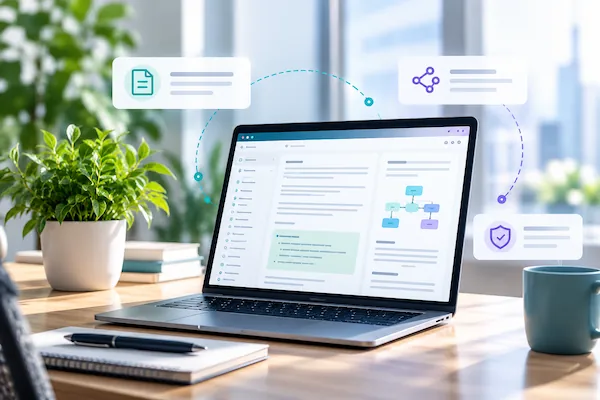
The information your team needs to move forward.
It’s not about producing documentation for its own sake. It’s about preserving what a team needs to work with confidence.
Application architecture map
Components, integrations, dependencies, and critical areas. What exists, how it connects, and what a change might affect.
Operational procedures
How to set up environments, test changes, deploy releases, and restore service when an incident occurs.
Decision history and tests
Why important changes were made, which problems they solved, and how to verify that features still work as intended.
If the team changes tomorrow, the knowledge shouldn't leave with them. That's why we keep documentation up to date alongside the product, rather than treating it as a one-off deliverable that quickly becomes outdated.
Your software needs to keep running.
And your business needs to keep moving forward.
Tell us which application you need to maintain, what challenges you are facing, and what you would like to improve. We will help you identify where to start.
Tell us what you need to maintain or improve.
Share a little context and we’ll get back to you to discuss the next steps.