
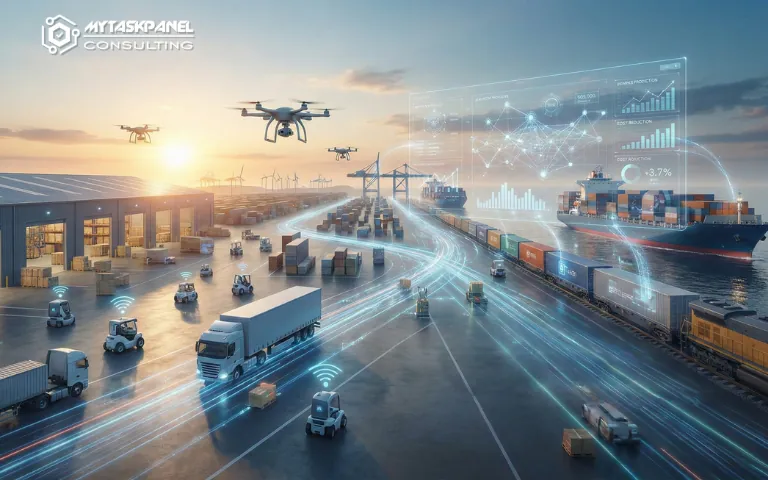
In an increasingly competitive business world, supply chain optimization with AI has become a strategic priority. Companies can no longer rely solely on manual efficiency; they need to integrate intelligent technologies that allow them to anticipate demand, reduce costs, and respond quickly to market changes.
This article is aimed at company executives and technology consultancies, with a practical and strategic focus that includes definitions, benefits, challenges, trends, and real-world success stories.
What is supply chain optimization with AI?
The supply chain is the complete system of processes that a company uses to produce and deliver products or services. Optimizing this chain means improving its performance to reduce costs, time, and errors.
When we apply AI to the supply chain, we enhance processes and equip them with predictive and real-time adaptive capabilities. This means decisions are made based on historical data, while AI anticipates future scenarios and suggests optimal actions.
Example: A retail company uses AI to forecast demand across different regions and automatically adjust inventory in each warehouse, avoiding overstocking or stockouts.
Key benefits of supply chain optimization with AI
1. Greater accuracy in demand forecasting
AI can analyze large volumes of internal and external data (weather factors, consumer trends, macroeconomic variables) to forecast demand with high accuracy.
2. Reduction of operating costs
AI identifies inefficiencies in the supply chain and proposes automatic adjustments, reducing waste and optimizing the use of resources.
3. Improved response speed
With AI, companies can react quickly to disruptions or changes in demand, minimizing negative impacts.
4. Greater visibility and traceability
AI integrates data from multiple systems in real time, providing full visibility across the supply chain and improving quality control.
Example: A food company uses AI to track each batch from production to the final customer, ensuring quality and compliance with health regulations.
How to implement supply chain optimization with AI
1. Initial assessment
It is essential to conduct a thorough diagnosis of the current supply chain, identifying weaknesses, bottlenecks, and areas where AI can add value.
2. Selection of priority use cases
Not all processes require AI. It is advisable to start with critical areas such as inventory management, demand forecasting, or logistics.
3. Technology integration
AI must be integrated with ERP systems, WMS (warehouse management systems), CRM, and other enterprise platforms to ensure efficient data flow.
4. Training and change management
Success depends on preparing teams to work with new tools and fostering a culture oriented toward innovation.
Real-world cases of supply chain optimization with AI
Case 1: Global retail
A retail chain integrated AI into its supply chain to optimize inventory replenishment. This reduced losses due to excess stock by 25% and improved product availability by 15%.
Case 2: Automotive industry
A manufacturer implemented AI to anticipate spare parts needs and adjust its logistics. As a result, it reduced delivery times by 20% and optimized storage costs.
Case 3: Logistics and transportation
A logistics company used AI to optimize transport routes by considering traffic, weather conditions, and demand. This reduced transportation costs by 18% and improved on-time delivery.
Challenges in implementation
Although AI offers great opportunities, supply chain optimization faces several challenges:
- Data quality: AI depends on accurate and complete data.
- Complex integration: the supply chain involves multiple systems and suppliers.
- Cultural change: internal resistance must be overcome and processes adapted.
- Initial investment: AI adoption requires investment in technology and training.
Overcoming these challenges requires leadership, strategic vision, and cross-functional collaboration.
Future trends in supply chain optimization with AI
Technological evolution will bring significant changes:
- Digital twins: virtual representations of the supply chain to forecast scenarios before implementing changes.
- Advanced predictive AI: the ability to anticipate disruptions and adapt in real time.
- Blockchain and AI: greater traceability and security in global supply chains.
- Intelligent automation: processes that automatically adjust to changing conditions without human intervention.
These trends point to a future in which the supply chain will be more efficient, autonomous, and resilient.
Supply chain optimization with AI is not just a technical improvement, but a strategic shift that impacts a company’s competitiveness, efficiency, and adaptability. Implementing AI in the supply chain makes it possible to anticipate demand, reduce costs, improve quality, and respond quickly to market fluctuations.
If your company wants to lead in efficiency and adaptability, now is the time to explore how AI can transform your supply chain. At MyTaskPanel Consulting, we have the experience and strategic approach to guide you on this journey. Contact us and discover how we can help you optimize your supply chain and turn innovation into a competitive advantage.


