
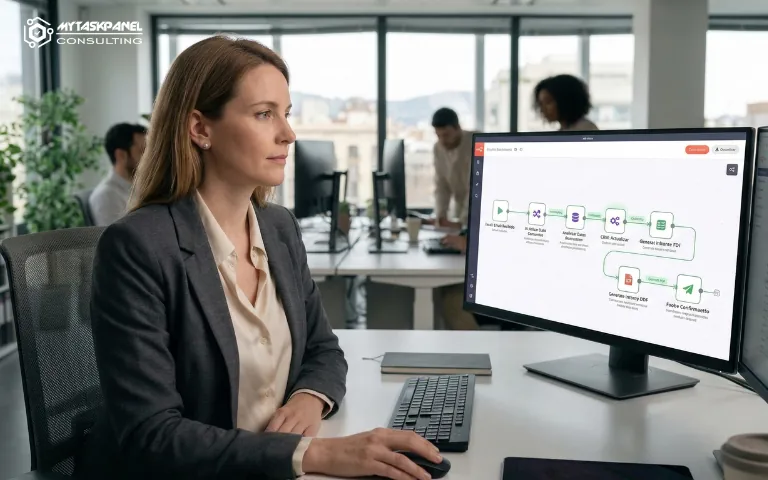
Administrative work is one of the major “hidden costs” within organizations. It does not always appear as a clear line item in the budget, but it consumes thousands of hours each year in repetitive, manual, low–value-added tasks: entering data, reviewing documents, sending emails, moving information between systems, following up on processes, or generating reports.
In this context, automating administrative work has become a strategic priority for many companies that want to grow without increasing headcount, improve internal efficiency, and free their teams to focus on truly strategic tasks. The combination of artificial intelligence (AI) and automation platforms such as n8n creates a clear opportunity to achieve this in a flexible, scalable way with real impact.
This article explains what it means to automate administrative work with AI and n8n, the benefits it offers, practical use cases, and the key considerations leadership must address to implement it successfully.
The problem with administrative work today
In many organizations, a significant portion of qualified employees’ time is spent on tasks that do not create differentiated value:
- Copying and pasting information between tools.
- Reviewing and classifying emails or documents.
- Generating recurring reports.
- Manually following up on internal processes.
- Coordinating tasks across departments.
Although these activities are necessary, their direct impact on the business is limited.
They also generate:
- Operational inefficiency.
- Risk of human error.
- Team overload.
- Slower decision-making.
- Difficulty scaling.
This is where automating administrative work stops being an operational improvement and becomes a lever for competitiveness.
What does it mean to automate administrative work with AI?
Automating administrative work is not simply about “adding robots” or eliminating people. From a leadership perspective, it means redesigning internal processes so that technology handles repetitive tasks, while people focus on analysis, decision-making, and relationships.
AI contributes the ability to:
- Understand text, documents, and natural language.
- Classify information intelligently.
- Generate summaries, responses, or reports.
- Make decisions based on rules and context.
- Learn from recurring patterns.
This makes it possible to automate not only mechanical tasks, but also administrative tasks that involve cognitive components.
The role of n8n in administrative automation
n8n is a process automation platform that acts as an orchestrator between different tools and systems within the company. Its value lies not in a single use case, but in its ability to connect complete workflows.
From a non-technical perspective, n8n enables organizations to:
- Connect internal and external applications.
- Define automation rules between systems.
- Execute processes automatically and in a controlled way.
- Integrate AI within administrative workflows.
- Scale automations without relying on complex development.
The combination of AI + n8n allows companies to move from simple automations to intelligent, end-to-end administrative processes.
What does this automation really mean for the company?
Changing the way work is done
Processes no longer depend on people remembering steps or manually executing tasks. The workflow is defined, automated, and supervised.
Standardizing operations
Automation reduces variability, errors, and dependence on specific individuals. Processes are executed consistently.
Gaining visibility
Every step of the process is logged. This allows organizations to measure time, identify bottlenecks, and uncover improvement opportunities.
Freeing up talent
Administrative teams can dedicate their time to higher-value tasks: analysis, coordination, continuous improvement, and strategic support.
Practical examples of automating administrative work
Email and internal request management
A large volume of administrative work begins in email. With AI and n8n, companies can:
- Automatically read incoming emails.
- Classify them by type (billing, support, HR, suppliers).
- Extract key information.
- Create tasks or records in other systems.
- Send automated or assisted responses.
This drastically reduces time spent in the inbox and improves response times.
Invoice and document automation
In financial and administrative areas, automation can:
- Automatically read invoices and documents.
- Validate key information.
- Classify documents.
- Send data to the accounting system.
- Generate alerts if information is missing.
AI interprets the documents, and n8n connects the systems—eliminating manual steps and reducing errors.
Administrative onboarding of clients or suppliers
Registering new clients or suppliers often involves multiple steps:
- Data collection.
- Documentation validation.
- Creating records in multiple systems.
- Communication between departments.
With AI and n8n, this process can be automated end-to-end:
- Smart forms.
- Automatic data validation.
- Record creation.
- Communication dispatch.
- Automated follow-up.
This accelerates the process and improves the experience from the first interaction.
Report generation and reporting
Many teams spend hours preparing recurring reports. Automation makes it possible to:
- Collect data from multiple sources.
- Analyze it automatically.
- Generate clear AI-driven summaries.
- Send periodic reports to management.
Information arrives faster, better structured, and with less effort.
Administrative project management
In internal projects, automation can:
- Automatically create tasks based on events.
- Update statuses across tools.
- Send reminders and alerts.
- Generate progress summaries.
This reduces coordination work and improves visibility for leadership.
Strategic benefits of automating administrative work
- Time and cost savings. Fewer hours spent on repetitive tasks and fewer errors to correct.
- Scalability. The company can grow without proportionally increasing the administrative team.
- Greater control and traceability. All processes are documented and measurable.
- Improved internal experience. Teams work with less friction and greater clarity.
- Better decision-making. Leadership has access to faster, more structured, and more reliable information.
Risks and common mistakes to avoid
Automating administrative work also requires sound judgment:
- Automating inefficient processes. If the process is flawed, automating it will only make it faster—not better.
- Lack of oversight. AI should support—not replace—human control in critical processes.
- A purely technological focus. Automation is a business initiative, not just an IT project.
- Resistance to change. It is essential to communicate that automation frees up time and improves work—it does not eliminate people.
How to get started with real impact
An effective leadership approach typically follows these steps:
- Identify repetitive and costly administrative tasks.
- Prioritize high-volume, low–value-added processes.
- Define clear objectives (time, cost, quality).
- Redesign the process before automating.
- Implement pilot projects with AI and n8n.
- Measure results and scale progressively.
This approach reduces risk and ensures return on investment.
The role of leadership in automation success
Automating administrative work does not succeed without leadership. Management must:
- Drive the vision.
- Prioritize key processes.
- Align teams.
- Define boundaries and governance.
- Measure real impact.
When this happens, automation stops being just a tool and becomes a structural advantage.
Conclusion: efficiency today, competitiveness tomorrow
Automating administrative work with AI and n8n enables organizations to do more with less, reduce internal friction, and unlock the true potential of their teams. It is not only about efficiency, but about building a more agile, scalable, and future-ready company.
At MyTaskPanel Consulting, we help companies identify, design, and implement AI- and n8n-based administrative automations, always with a clear objective: generating real business impact. If you want to automate your company’s administrative work and gain efficiency from the first month, let’s talk. We help you transform manual processes into intelligent workflows.


