
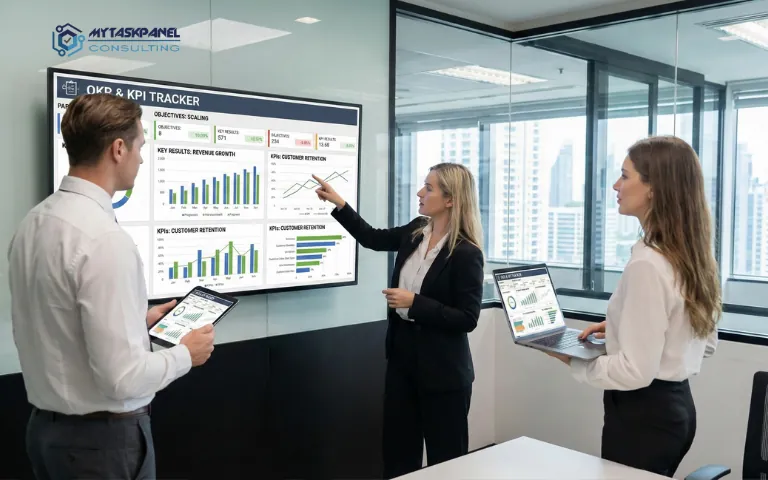
In recent years, many scaleups and technology companies have adopted methodologies such as OKRs (Objectives and Key Results) to align goals, prioritize initiatives, and maintain focus during periods of rapid growth. The theory is solid: define clear objectives, measure results, and regularly review progress.
In practice, however, the biggest challenge is not usually the definition of OKRs, but their day-to-day tracking. As teams grow, tools multiply, and pressure for results increases, KPI monitoring often becomes irregular, manual, and difficult to turn into action.
This article presents a success story in which we helped a high-growth technology company automate the tracking of OKRs and KPIs, turning them into a truly operational decision-making tool—without adding administrative burden or more meetings.
The context: well-defined OKRs, but limited real visibility
The company had done solid work at a strategic level. It had:
- Quarterly OKRs defined at company and team levels.
- Clear KPIs linked to each objective.
- A leadership team aligned with the methodology.
- Established tools to run the business.
Even so, weekly tracking was not working as it should.
What was happening day to day?
The tracking process relied heavily on people:
- Each owner had to update metrics manually.
- Data came from multiple tools.
- Weekly check-ins were delayed or skipped.
- Information arrived incomplete or outdated.
As a result, OKRs lost their practical function. They were reviewed at the end of the quarter, when it was already too late to correct meaningful deviations.
A common problem in growing companies
This scenario is very common in scaleups and technology companies that:
- Grow rapidly.
- Operate with distributed teams.
- Use multiple tools (CRM, product, finance, marketing).
- Work under constant pressure.
In this context, asking teams to spend time each week manually collecting and reporting KPIs usually fails—not due to lack of commitment, but because the process competes with more urgent and visible tasks.
The result is clear: OKRs become a theoretical framework rather than a continuous management tool.
The goal: making OKRs useful for decision-making again
When the company contacted us, the goal was not to change methodologies or add more tools. What they wanted was much more concrete:
- Automate KPI collection.
- Gain real weekly visibility into progress.
- Detect deviations before they impacted the quarter.
- Reduce unproductive follow-up meetings.
- Keep the entire organization aligned around real data.
In short, they wanted to scale without losing focus.
The solution: intelligent automation of OKR and KPI tracking
At MyTaskPanel Consulting, we designed a solution based on automation with n8n and AI, directly connected to the tools the company was already using.
The guiding principle was simple but crucial: if the data already exists in the systems, there is no reason to ask people to collect it manually.
Direct connection to real data sources
The first step was identifying where the KPIs associated with the OKRs actually lived:
- CRM systems for commercial metrics.
- Financial tools and ERPs.
- Operational Google Sheets.
- Product tools.
- Other internal data sources.
The automated system connects to these sources and periodically extracts the KPIs, ensuring up-to-date and consistent data. This eliminated one of the biggest friction points in the process: manual updates.
Automated, actionable weekly check-ins
Once the data was consolidated, the system ran a weekly automated workflow that:
- Analyzed KPI trends.
- Calculated the level of achievement for each OKR.
- Detected relevant deviations.
- Identified positive and negative trends.
Using AI, a clear and actionable summary was generated—easy for leadership to understand without having to interpret spreadsheets or complex dashboards.
Early alerts to avoid end-of-quarter surprises
One of the biggest benefits of automation was the ability to anticipate problems.
The system automatically generated alerts when:
- A KPI deviated from its expected pace.
- An OKR became blocked.
- A key metric stalled.
This allowed the leadership team to act in time, instead of discovering issues when there was no longer room to maneuver.
Clear, shared visibility for the entire leadership team
All generated reports were automatically sent to the leadership team, with information that was:
- Clear.
- Structured.
- Comparable week over week.
- Based on real data.
This eliminated subjective interpretations and ensured that all areas worked from a single source of truth.
Results: direct impact on focus, alignment, and outcomes
Frictionless tracking
Data is automatically updated from the tools the company already uses. Teams stopped spending time on manual reporting.
Efficient weekly check-ins
AI-generated actionable summaries reduced the number of follow-up meetings and shifted conversations toward decisions rather than information gathering.
Significant improvement in goal achievement
Quarterly objective completion increased by 60%, thanks to continuous tracking and early detection of deviations.
Stronger cross-team alignment
All areas accessed consistent and clear reports, reducing internal friction and improving coordination between teams.
A key shift: from reactive tracking to proactive management
Before automation, OKRs were reviewed reactively. Afterward, they became a continuous management tool.
Leadership stopped asking “How are we doing?” and started making weekly decisions based on real data—without adding extra effort for teams.
Why this automation worked?
The success of the project was not only about technology, but about the approach:
- No additional administrative burden was added.
- Existing data was leveraged.
- Tracking was automated, not strategy.
- The solution was designed to scale.
At MyTaskPanel Consulting, we see automation as a lever to improve focus and execution, especially in high-growth environments.
This success story shows that the problem with OKRs is rarely the methodology itself. The real challenge is tracking.
Automating OKR and KPI monitoring allowed this company to align teams, improve results, and scale without losing visibility—turning objectives into a living management tool.
Want to scale without losing control of your objectives? At MyTaskPanel Consulting, we help technology and high-growth companies automate key processes such as OKR and KPI tracking, integrating them with their existing tools. Let’s talk and discover how to turn your objectives into data-driven decisions, not gut feelings.


