
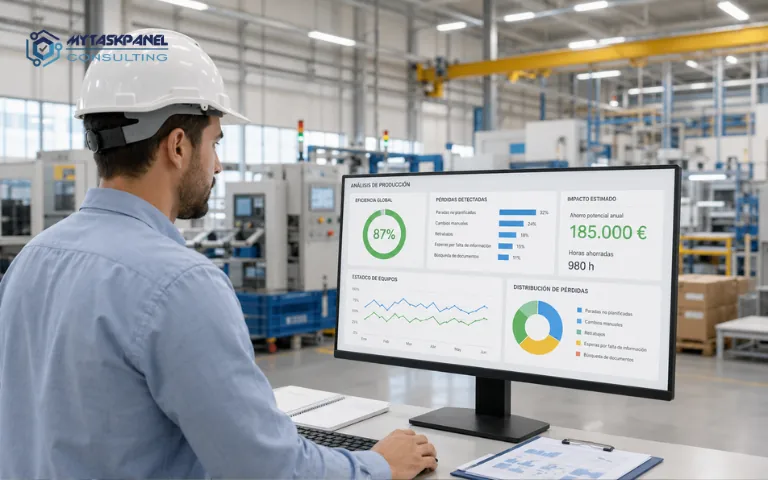
In many industrial companies, efficiency losses are not always found in the most visible problems. They often appear in manual tasks, disconnected data, reports prepared by hand, documentation that is difficult to find or decisions made with incomplete information. These inefficiencies may seem small, but when they are repeated every week, they end up generating a real cost in terms of time, productivity and responsiveness.
Artificial intelligence for industrial companies makes it possible to detect these friction points, automate processes and turn scattered data into operational savings.
Digitalized companies, but not always connected
Many industrial SMEs already use digital tools:
- ERP.
- Spreadsheets.
- Invoicing platforms.
- Stock systems.
- Shared folders.
- Internal applications.
But having digital tools does not mean having efficient processes. In many companies, each area works with its own information. Administration uses certain documents, Purchasing uses other records, Production updates its reports and Management receives data that often arrives late or incomplete.
The result is clear: the company has data, but it cannot always turn it into fast, reliable decisions.
Hidden inefficiencies that cost money
Some inefficiencies do not trigger an immediate alarm, but they directly affect profitability.
For example:
- Entering the same information into several systems.
- Searching for documents across emails and folders.
- Manually reviewing invoices, delivery notes or orders.
- Preparing reports by copying data into Excel.
- Depending on specific people to find key information.
- Making decisions with outdated or incomplete data.
The problem is repetition: when these processes are repeated every day, they consume hours, increase errors and make decision-making more difficult.
How does AI help?
Artificial intelligence can analyze processes and detect patterns that are not always visible.
For example, it can help identify:
- Which suppliers cause the most delays.
- Which orders require the most reviews.
- Which documents take longest to validate.
- Which tasks are repeated without adding value.
- Where administrative errors occur most often.
- Which processes depend too heavily on one person.
The key is to answer specific questions:
- Where is the most time being lost?
- Which errors are repeated?
- What information does management need sooner?
- Which tasks could be automated?
- Where is the greatest economic impact?
When these questions are answered with data, the company can prioritize better.
Document automation
One of the most useful applications of AI in industrial companies is document automation.
Many companies work every day with:
- Invoices.
- Delivery notes.
- Purchase orders.
- Work reports.
- Technical sheets.
- Certificates.
- Supplier documentation.
AI can read, classify and extract relevant information from these documents: supplier, date, amount, order number, reference, quantity or agreed conditions.
Then, that information can be automatically compared with the ERP or other internal systems. If everything matches, the process moves forward. If there is a difference, the system generates an alert. This way, the team only reviews the cases that require attention and reduces repetitive tasks.
Automatic reports to make decisions earlier
Another common source of inefficiency is manual reporting. In many industrial companies, production, purchasing, sales, stock, quality or administration reports still depend on slow processes: exporting data, organizing it in Excel, checking formulas and preparing conclusions.
With AI and automation, these reports can be generated automatically and connected to the company’s systems.
For example, Management could receive reports on:
- Orders at risk of delay.
- Materials with higher-than-expected consumption.
- Suppliers with more incidents.
- Cost deviations.
- Processes where errors are repeated.
The value lies in moving from looking at outdated data to making decisions with more up-to-date information.
Purchasing, inventory and internal knowledge
AI can also add value in purchasing and inventory.
Having too much stock ties up capital. Having too little stock can create urgent needs, delays and problems with clients. With historical data, AI can analyze:
- Consumption patterns.
- Delivery times.
- Material turnover.
- Supplier behavior.
- Risks of stock shortages or excess stock.
It can also help organize internal knowledge. Procedures, manuals, work instructions, technical documentation or incident histories are often spread across folders, emails and internal files. With intelligent search systems, teams can find answers faster and depend less on specific people.
Start with a specific process
Adopting AI does not mean transforming the entire factory from day one.
The best approach is to start with a small, specific and measurable process. For example:
- Automating the review of invoices and delivery notes.
- Generating automatic reports.
- Classifying internal incidents.
- Creating alerts for orders or suppliers.
- Organizing technical documentation.
- Analyzing material consumption.
The initial goal should be to solve a specific operational problem. If the first use case demonstrates time savings, error reduction or better decision-making, it can be scaled to other processes.
From hidden inefficiencies to real savings
Artificial intelligence for industrial companies can start with very specific tasks: repetitive processes, manual reports, scattered documentation or data that is not currently connected. Applied with clear criteria, it helps detect hidden inefficiencies, reduce errors, save time and improve decision-making.
At MyTaskPanel Consulting, we help industrial companies transform manual processes into intelligent solutions: automation of administrative tasks, integration with ERP and internal tools, automatic report generation, data analysis and custom software development with AI.
Do you want to know where AI could add value in your industrial company? We analyze your processes, detect automation opportunities and design a solution adapted to your systems and business objectives.


