
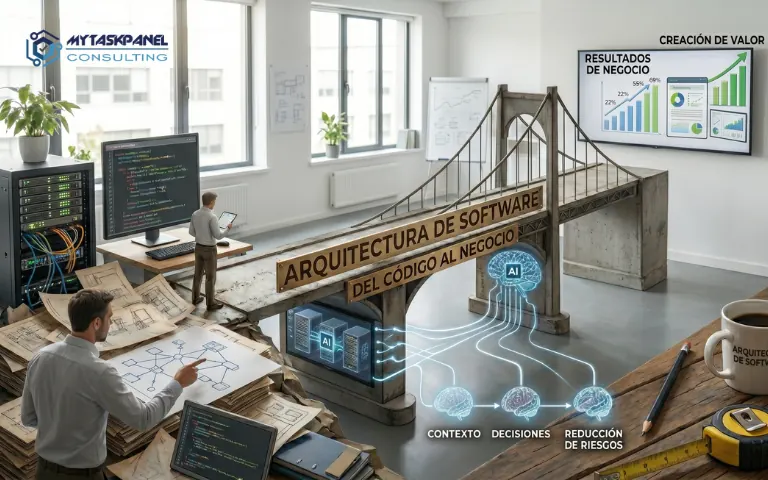
Software architecture in the age of AI is changing software development, the role of technical teams, and the way companies make technology decisions.
This article is based on the ideas shared on the LambdaCast podcast, in a conversation with Carlos Buenosvinos, technology executive, advisor, and VP Digital at IFCO, where they discuss how AI is shifting the focus: from writing more code to solving business problems better.
The change is not just about using tools like Cursor, Codex, Windsurf, or Claude Code. The real impact lies in how teams understand context, decide what to build, reduce risks, and turn technology into value.
Architecture should no longer be just a role
In many companies, software architecture has been associated with a separate figure within the team: someone who defines rules, makes technical decisions, and designs systems from a position that is removed from day-to-day implementation. That model makes less and less sense.
In the age of AI, architecture works better as a distributed capability. It is not just about having one person with the title of architect, but about ensuring that the team has the judgment to make good technical decisions.
This means understanding:
- What business problem needs to be solved.
- Which solution makes the most sense.
- What technical risks are being assumed.
- Which parts of the system should remain separate.
- Which dependencies should be avoided.
- What impact each decision will have in the medium and long term.
Architecture does not disappear. It becomes a cross-functional skill within the team.
AI reduces the cost of building software
One of the major changes introduced by artificial intelligence is the reduction in development costs.
Tasks that used to take months can now be solved in weeks. Processes that used to require weeks can now be tackled in days. And developments that used to take days can be completed in hours. This changes a classic technology conversation: build or buy.
For a long time, companies preferred to buy external solutions because building internally was expensive, slow, and complex. With AI, that calculation is beginning to change.
If building becomes cheaper, some internal solutions that previously did not make sense may now become viable.
But this does not mean that every solution should be custom-built. The decision still depends on several factors:
- The real value of the problem.
- The cost of building and maintaining the solution.
- The required level of quality.
- The strategic importance of the solution.
- The responsibility the company wants to assume.
- The internal capacity to evolve it over time.
Less tactical architecture, more high-level architecture
In this new scenario, it is useful to distinguish between tactical architecture and high-level architecture. Tactical architecture has to do with internal code decisions: how to organize folders, where to place a class, which pattern to apply, or how to structure a specific part of the application.
These decisions will continue to exist, but they may lose human prominence as AI becomes capable of generating and adapting code based on clear instructions.
High-level architecture, on the other hand, becomes increasingly important. This includes decisions such as:
- How systems communicate with each other.
- What contracts exist between services.
- Which APIs are defined.
- Which events are emitted.
- Which dependencies are accepted.
- Which parts of the system should be separated.
- Which technical risks are worth taking.
- How technology connects with the business.
Teams may think less about the internal structure of each block of code, but they will need to think more carefully about boundaries, interfaces, context, and strategic decisions.
AI accelerates both the good and the bad
Artificial intelligence does not automatically turn a poor system into a good one. Nor does it transform a disorganized team into an excellent team.
AI is an accelerator. If a team has good habits, clear documentation, tests, technical standards, and working agreements, AI can multiply its capacity. It can help migrate code, create features, maintain existing systems, and deliver solutions faster.
But if the team works without judgment, documentation, or standards, AI can also accelerate disorder. It can generate more technical debt, more inconsistencies, and more fragility. That is why the point is not simply to use AI. The point is to use it within an environment that is healthy enough.
Working agreements for AI too
Working agreements have always helped define how a team works: quality criteria, code review, testing, collaboration, stakeholder relationships, and technical standards.
With AI, these agreements become even more valuable. Why? Because they can become reusable instructions for AI agents. In other words, what once helped align people can now also help align the tools that generate code.
A team can define:
- How solutions should be structured.
- What testing style is expected.
- Which code conventions must be followed.
- Which patterns are used.
- Which quality criteria are mandatory.
- What business context must be taken into account.
AI does not only need prompts. It needs context, rules, and judgment.
Code is no longer the center
For quite some time, many technical profiles have defined their value by their ability to write code. But in a context where AI can generate more and more code, that definition falls short.
Code is a tool, not the goal. The goal is to solve business problems. This changes the value of technical profiles. The most relevant developer will not necessarily be the one who knows the most frameworks or writes the most lines of code, but the one who understands context, speaks with the business, identifies opportunities, and uses technology as a means to create impact.
The profile that simply waits for closed tasks will have less room for differentiation. By contrast, the profile capable of connecting technology and business will become increasingly valuable.
Good practices, yes. Dogmas, no
The fact that AI accelerates development does not mean that good practices stop mattering. Testing, clean architecture, separation of responsibilities, and SOLID principles still make sense because they help reduce maintenance costs, improve quality, and decrease errors.
What changes is that there is now a tool capable of reducing the time between an idea and its deployment to production. The key is to use it with judgment.
It is not about applying AI everywhere. Nor is it about applying complex architecture where it is not needed. The question remains the same: What problem do we want to solve, and what is the minimum technology required to solve it well?
Legacy, context, and control
One of the greatest risks of AI appears in legacy or critical systems. If a codebase already has technical debt, inconsistent patterns, or unfinished migrations, AI can copy poor decisions and reinforce existing problems.
That is why not all contexts are the same. In well-structured projects, with tests, documentation, and clear agreements, AI can work more safely. In critical or legacy systems, it is better to move forward in a controlled way.
A reasonable way to do this is with an engineering mindset:
- Formulate a hypothesis.
- Test it in a limited environment.
- Measure results.
- Adjust before scaling.
Conclusion: architecture is changing, but it is becoming more important
Software architecture in the age of AI is not disappearing. What is losing relevance is part of the obsession with tactical architecture: folders, patterns, or the internal structure of code. The architecture that is gaining importance is the one that understands the business, defines good boundaries, designs clear contracts, decides when to build and when to buy, and reduces risks without slowing down speed.
AI can write code, but it needs direction. It can accelerate development, but it needs judgment. And it can generate solutions, but someone needs to understand which problem is worth solving.
At MyTaskPanel Consulting, we help companies make better technology decisions, integrate AI into their development processes, and design software solutions connected to real business goals. Do you want to explore how AI can improve your software development without increasing technical debt or losing control? We analyze your context, systems, and processes to define a useful, scalable technology strategy aligned with your business.


