
The role of the CTO has changed radically in recent years. It is no longer just about ensuring that technology works or keeping infrastructure stable. Today, technology is a direct lever for growth, efficiency, and differentiation. In this context, a key concept emerges: the new modern CTO stack.
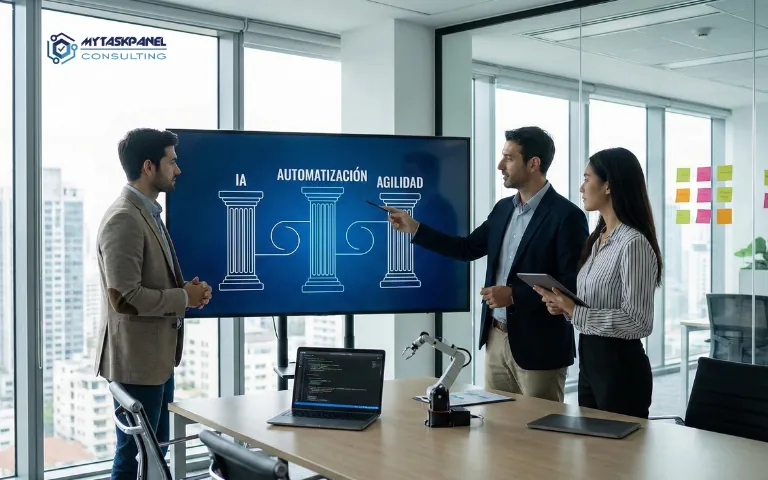
This new stack is not defined solely by tools or programming languages, but by a strategic combination of capabilities that allow organizations to adapt quickly, scale with control, and compete in increasingly digital markets. Three elements stand out as fundamental: artificial intelligence, automation, and agility.
This article explores what this new stack really entails, why it is critical for technology leadership, and how it impacts the business.
What do we mean by the new modern CTO stack?
Traditionally, the technology stack referred to technical layers: infrastructure, backend, frontend, databases, security. Today, that view is no longer sufficient. The new modern CTO stack is built on strategic capabilities, not just on technology.
This new stack answers key questions such as:
- How do we use technology to scale without losing control?
- How do we accelerate decision-making with data?
- How do we reduce dependence on manual processes?
- How do we adapt the organization to constant change?
More than a set of tools, the new stack is a technological operating model, aligned with business objectives and with the speed the market demands.
Artificial intelligence: from experiment to structural layer
AI as a real competitive advantage
In the new modern CTO stack, artificial intelligence stops being an isolated project or an innovation lab and becomes a cross-cutting layer that impacts multiple areas: operations, product, marketing, finance, and customer support.
AI enables organizations to:
- Analyze large volumes of data in real time.
- Automate complex decisions.
- Anticipate behaviors and risks.
- Personalize experiences at scale.
- Continuously optimize processes.
For the CTO, the question is no longer whether to adopt AI, but how to integrate it in a sustainable and well-governed way.
Examples of AI integrated into the stack
- AI for incident prioritization and internal support.
- Predictive systems for demand, churn, or fraud.
- Intelligent assistants for internal teams.
- AI applied to testing, software quality, and security.
- Automated analysis of operational and business metrics.
The key is ensuring that AI does not live on the margins of the stack, but is embedded into the organization’s daily workflows.
Automation: scaling without increasing complexity
From isolated efficiency to systemic efficiency
Automation is the second pillar of the new modern CTO stack. It is not just about saving time, but about reducing dependence on manual processes, minimizing errors, and freeing talent to focus on higher-value tasks.
A modern CTO understands that every repetitive manual process is a missed opportunity to scale more effectively.
Well-designed automation makes it possible to:
- Run processes 24/7 without human intervention.
- Reduce response times.
- Increase operational reliability.
- Standardize best practices.
- Enable frictionless growth.
Automation beyond IT
One of the key shifts in the new stack is that automation is no longer limited to the technical domain. Its impact is cross-functional:
- Automated onboarding for customers and employees.
- Automated workflows between sales, operations, and finance.
- Automated incident and task management.
- Process orchestration across multiple tools.
The CTO moves from being a systems manager to a digital process architect.
Agility: the most critical capability in the stack
Agility is not speed without control
In the new modern CTO stack, agility does not mean improvisation or lack of rigor. It means the ability to adapt quickly with control, based on processes, metrics, and continuous feedback.
Agility enables organizations to:
- Respond quickly to market changes.
- Reduce time to market.
- Better prioritize technology investments.
- Learn faster than competitors.
- Minimize the cost of failure.
For technology leadership, agility is a structural advantage, not a one-off methodology.
Culture, processes, and technology
Agility is not driven by tools alone. It requires:
- Autonomous but aligned teams.
- Clear prioritization processes.
- Visibility into work and dependencies.
- Metrics focused on value, not just activity.
- Real collaboration between technology and business.
The new modern CTO stack integrates platforms that support this agility, while also driving cultural and organizational change.
How AI, automation, and agility connect?
The real power of the new stack emerges when these three pillars work together:
- AI detects patterns, opportunities, and risks.
- Automation executes actions consistently.
- Agility allows the strategy to be adjusted quickly.
For example:
- AI detects an operational bottleneck.
- An automated workflow reallocates tasks or resources.
- The team adjusts priorities in real time.
This approach turns technology into a living system, capable of continuous adaptation.
Business impact of the new stack
- Sustainable scalability: the company can grow without technological complexity increasing at the same pace.
- Improved decision-making: AI and data enable faster, more informed, and more objective decisions.
- Reduced operating costs: automation reduces errors, rework, and manual dependencies.
- Stronger alignment between technology and business: agility and visibility better connect technical priorities with strategic objectives.
- Talent attraction and retention: technology teams prefer modern, automated environments with real impact.
Challenges the CTO must manage
- Technology fragmentation: without a clear vision, tool adoption can create a scattered and hard-to-govern ecosystem.
- Governance and security: AI and automation require clear controls, access management, and regulatory compliance.
- Organizational change: the new stack demands new ways of working. Resistance to change is one of the main risks.
- Value measurement: not all impact is immediate. Defining clear success and ROI metrics is essential.
How to start building the new modern CTO stack?
It is not about changing everything at once. A progressive approach is usually more effective:
- Assess the current state of the stack and processes.
- Identify bottlenecks and high-impact areas.
- Prioritize use cases where AI and automation deliver value.
- Consolidate tools and workflows to gain visibility.
- Measure results and continuously adjust.
The CTO must lead this process with a clear vision aligned with executive leadership.
Example of stack evolution
A growing company might:
- Start by automating key operational processes.
- Introduce AI for predictive analytics and internal support.
- Adopt platforms that improve visibility and collaboration.
- Iterate toward a more agile, data-driven model.
The result is a lighter, smarter stack that is ready to scale.
Conclusion: technology as a leadership engine
The new modern CTO stack is not a trend or a checklist of tools. It is a different way of understanding the role of technology in the organization—as a driver of agility, efficiency, and growth.
The combination of AI, automation, and agility enables organizations to adapt faster, operate better, and make higher-impact decisions. For the CTO, leading this transformation is an opportunity to move from technology manager to strategic business leader.
At MyTaskPanel Consulting, we support CTOs and executive teams in designing and implementing modern technology stacks aligned with real business objectives. If you want to evolve your technology stack and prepare your organization for the future, let’s talk.


