
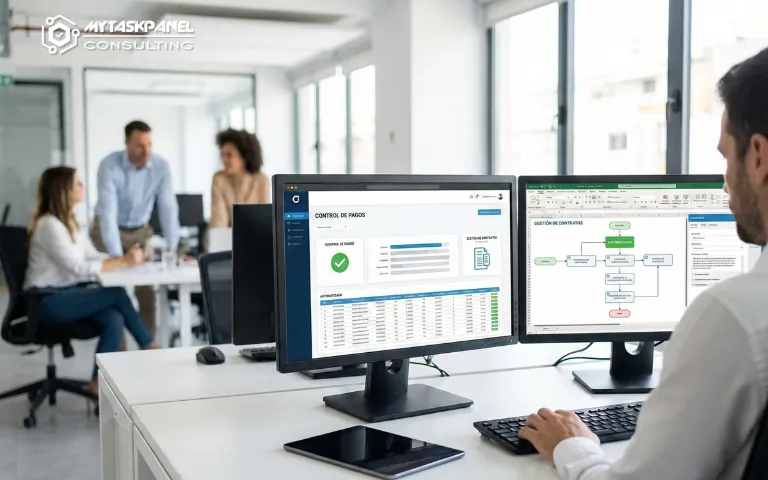
The back office is the silent heart of any company. It is home to administrative processes that are essential to daily operations: payment control, invoicing, contract management, customer tracking, and account reconciliation. The problem is that these tasks are often repetitive, prone to human error, and consume a large amount of resources. This is where the opportunity arises to automate the back office, leveraging technologies such as robotic process automation (RPA) and artificial intelligence (AI).
In this article, we will explore how automation transforms administrative efficiency, the strategic benefits it offers, and concrete examples already being implemented by leading companies.
Why has back-office automation become essential?
Administrative departments typically face three major challenges:
- Manual, slow processes: data entry, invoice verification, and document management take significant time.
- Human errors: a single incorrectly entered figure can lead to financial or legal issues.
- Limited scalability: as the company grows, administrative tasks increase exponentially, making it unsustainable to scale staff at the same pace.
Automating the back office helps overcome these challenges by freeing up time for strategic tasks, ensuring data accuracy, and reducing operational costs.
Real example: A technology consulting firm that receives more than 1,000 invoices per month implemented an RPA system that automatically extracts data, validates information, and records it in the ERP. The result: an 80% reduction in processing time and nearly zero errors.
Error-free payment control thanks to automation
Payment control is one of the most critical back-office functions. Delays or mistakes in this area can lead to penalties, loss of supplier trust, or cash flow issues.
With RPA, tasks such as the following can be automated:
- Automatic reading and validation of invoices.
- Real-time bank reconciliation.
- Scheduling of recurring payments without manual intervention.
When combined with AI, it becomes possible to detect anomalies, predict liquidity risks, and even suggest payment schedule adjustments to optimize treasury.
Example: An AI system can identify unusual spending patterns in invoices and generate alerts for potential fraud, preventing million-dollar losses.
Faster, safer contract management
Contracts often create a heavy administrative burden: drafting, reviewing, signing, renewing, and storing. Companies frequently miss opportunities or face penalties simply because key dates are not properly monitored.
Automating this process provides clear benefits:
- Automatic contract generation: smart templates tailored to each customer or supplier
- Deadline monitoring: automatic alerts for expirations or renewals
- Integrated digital signatures: eliminating paper and increasing legal security
- AI-based document classification: automatic organization of contracts in digital repositories using OCR
Practical example: An outsourcing company implemented an automated system to manage contracts for its 500+ suppliers. Thanks to AI, it now receives renewal alerts 30 days in advance, preventing supply chain disruptions.
More efficient customer management with an intelligent back office
The back office also plays a key indirect role in customer experience. Accuracy in billing, on-time delivery, and communication quality depend largely on internal processes.
Automating back-office tasks in customer management includes:
- Automatic CRM data updates from emails, forms, or calls.
- Ticket or request tracking through bots that route information.
- Recurring billing without manual intervention.
- Automated reports with satisfaction metrics and service usage.
Example: A SaaS company serving thousands of customers integrated a system that connects CRM with automated billing. Every time a customer renews a service, the system generates the invoice, updates the database, and notifies the customer—without human intervention.
Strategic benefits of back office automation
Automation not only reduces costs—it transforms how companies operate:
- Operational efficiency: up to 70% reduction in time spent on repetitive tasks.
- Accuracy: elimination of human errors in calculations, payments, and records.
- Regulatory compliance: auditable records and full traceability.
- Scalability: ability to handle more operations without increasing administrative staff.
- Improved customer experience: smoother processes and faster responses.
Best practices for implementing back office automation
- Conduct process analysis: identify repetitive, manual, high-volume tasks.
- Prioritize critical areas: start with payments, contracts, and invoicing, where ROI is highest.
- Involve the human team: automation doesn’t replace—it frees people for higher-value tasks.
- Measure results with clear KPIs: time savings, error reduction, response time improvements.
- Scale gradually: begin with key processes and expand to other departments.
Conclusion: back office automation as a driver of business transformation
Automating the back office is no longer optional—it is essential for companies seeking efficient growth, risk reduction, and better customer service. With technologies such as AI and RPA, it is possible to transform critical processes like payments, contracts, and customer management into faster, safer, error-free workflows.
If your organization is ready to take this step toward efficiency and innovation, MyTaskPanel Consulting has the expertise and knowledge to support you in analyzing, designing, and implementing automation solutions tailored to your needs.
Contact us today and discover how we can help you optimize your back office and unlock your company’s true potential.


