
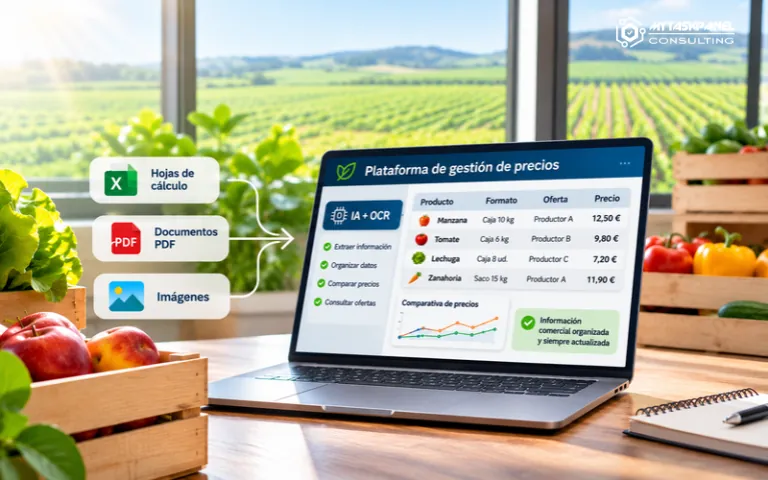
In the agri-food sector, managing offers from multiple producers involves reviewing prices, formats, and product names that change frequently. When information arrives in spreadsheets, PDF documents, or images, comparing it can become a time-consuming manual task.
At MyTaskPanel Consulting, we developed a price management platform using artificial intelligence and Optical Character Recognition (OCR) for an agri-food company, making it easier to organize and access its commercial information.
The challenge: scattered offers and manual data entry
Our client needed to consolidate purchase prices from different producers. Offers arrived in Excel files, PDFs, images, and documents with different structures. The same type of product could appear under different names depending on the supplier, and the sales team had to interpret each file and transfer its data into a common format.
The process presented several challenges:
- Administrative workload: locating and transcribing prices required time and attention.
- Scattered information: offers were stored in documents with different structures.
- Comparison difficulties: product names were not always consistent across suppliers.
- Access to historical data: reviewing price trends required retrieving previous information.
- Risk of errors: manual transcription could introduce inconsistencies into the records.
The main problem was the difficulty of transforming this information into standardized, easily accessible data before making commercial decisions.
The objective: centralize information and streamline management
We needed to develop a solution that would fit our client’s existing operations. Requiring all producers to use the same template could create additional friction in supplier relationships and would not solve the challenge of processing documents already received.
For this reason, we focused on creating a centralized platform where the team could register offers, import documents, and validate extracted information before incorporating it into the price management system.
It was also essential to preserve the original files, provide access to historical data, and facilitate comparisons between producers. Automation needed to help the commercial team work with better-organized information without replacing their judgment in purchasing decisions.
Our solution: a web platform with AI and OCR
We designed and developed a web application optimized for desktop and mobile devices. The platform centralizes purchase price information and provides two ways to enter it: manual data entry or AI- and OCR-assisted import.
1. Centralizing offers in different formats
The first improvement was bringing commercial information together in a single environment.
Instead of relying on multiple files to check prices, the team can manage offers through a centralized platform.
This centralization makes information easier to access and enables users to work with organized data, regardless of each document’s original format. It also reduces dependence on individual files and makes it easier for different users to access the available information.
2. Information extraction using AI and OCR
One of the project’s main components was the integration of artificial intelligence and OCR technologies to simplify the processing of offers. OCR recognizes content in documents and images. Based on this extracted content, AI proposes a structured format for organizing the relevant data. This means users no longer need to manually reconstruct all the information from scratch.
However, we did not design the tool to automatically treat every extracted value as definitive. We incorporated a user review and validation stage. This control is essential in purchasing processes, where an incorrect figure can affect a negotiation or commercial decision.
3. Standardizing product names through equivalence mapping
Another challenge was that producers could use different names for equivalent products. To address this, we incorporated an equivalence mapping system that learns from associations confirmed by users. This makes it easier to organize offers and compare information that originally followed different product naming conventions.
The learning process is based on actual user validations. This allows the system to become more useful without automatically assuming that two references with similar names represent the same product.
4. Document retention and access to historical data
We also incorporated the ability to retain original documents. This provides traceability and makes it easier to refer back to the source whenever questions arise about a price, product reference, or specific offer.
In addition, the platform allows users to review, compare, and analyze price trends over time. This historical perspective is valuable for preparing negotiations, evaluating new offers, and understanding how specific commercial conditions have changed.
The results: more structured price management
By developing this platform, we created a centralized foundation for managing pricing information that previously arrived in scattered formats.
Assisted offer importing simplifies data entry, while human validation ensures that users retain control over the information being processed.
The main functional improvements include:
- Centralization of offers from different producers.
- Reduced need for manual transcription.
- More consistent organization of information.
- Easier price comparisons.
- Retention of original documents.
- Access to historical data and price trends.
- Data validation before information is added to the system.
- Access from desktop and mobile devices.
The result is a solution that provides a more organized foundation for managing commercial information and supporting purchasing decisions.
Key lessons from the project
This project demonstrated how business automation can deliver value without eliminating human involvement. In processes where information arrives in different formats, one of the most significant improvements is automating its extraction and structuring while keeping validation in the hands of the people responsible.
We also confirmed the importance of adapting technology to existing operations rather than forcing a company to change all its processes. This approach can be applied to other business areas that rely on price lists, catalogs, commercial proposals, or supplier documentation.
AI-powered price management automation makes it possible to transform scattered documents into more accessible, structured, and comparable information.
At MyTaskPanel Consulting, we develop custom solutions that combine artificial intelligence, OCR, and business software to simplify processes and improve operational efficiency. Does your company spend too much time collecting, recording, and comparing supplier information? Contact us, and we’ll explore how to automate the process.