
Business AI · Automation · Agents

AI and automation for business. Turn manual processes into systems that work for you.

We look at how your business operates, find where time is lost and build automated workflows, AI agents and integrations connected to your systems. Fewer repetitive tasks, fewer errors and more operational capacity without added complexity.

Process automationEnd-to-end workflows integrated with your operations. AI agentsCarry out tasks with rules, permissions and audit trails. Document AIReads, classifies and validates documents and unstructured data.
Where to start

AI starts where your workflows get stuck.

Before discussing models, agents or tools, we look for a much more useful signal: workloads growing faster than your team can handle. That is where AI and automation can start making a real difference.

01
As demand grows, so does manual work.

More customers, documents and requests mean more time spent reviewing, copying, checking and coordinating.

02
The information is there, but hard to use.

Emails, documents, databases and scattered knowledge force teams to piece the context together again and again.

03
The systems work, but the workflow does not.

ERPs, CRMs, email, spreadsheets and internal tools still rely on people to transfer information between them.

Explore automation opportunities
Operational friction map analysing workflow
Bottlenecks identified
Capacity unlocked
Bottleneck Read and classify information
Bottleneck Review and decide what to do
Bottleneck Transfer data between systems
Understand
Decide
Act
Workflow redesign AI + automation

Interpret, apply rules, take action and escalate only exceptions.

Capability Automate repetitive tasks
Capability Connect systems and actions
Capability Keep human judgement for exceptions
Goal: make growth possible without multiplying manual work. Faster · more connected · more scalable workflows
What we build

AI solutions for businesses. Built into your operations, not just a demo.

We design and implement AI systems connected to real-world processes, data and tools. The technology depends on the challenge, but the goal remains the same: operational improvements your team can use and measure.

We don’t start by asking “Where can we add AI?” We start by identifying which work is worth redesigning, then choose the right mix of models, agents, rules, automation and integrations.
01

AI-powered process automation

We turn fragmented, manual processes into end-to-end workflows that interpret information, apply rules, update systems and escalate only exceptions.
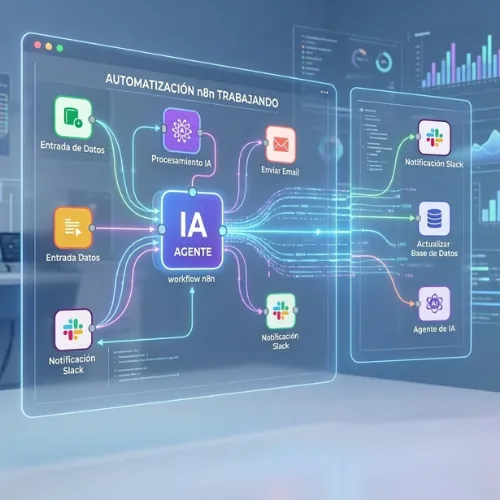
Back office Validation Operations Workflows
Visual representation of AI-powered automation and workflows
Automation Faster processes, less manual work
02

AI agents for tasks and processes

We build agents that can retrieve context, use tools and take action within clearly defined permissions, boundaries, oversight and audit trails.

Agents Tool use Orchestration Human-in-the-loop
Visual representation of AI agents connected to processes and tools
Agents AI that acts with context and clear boundaries
03

Intelligent document processing

We use AI to read, classify, extract and validate information automatically from documents, emails and other unstructured sources before it enters a workflow.
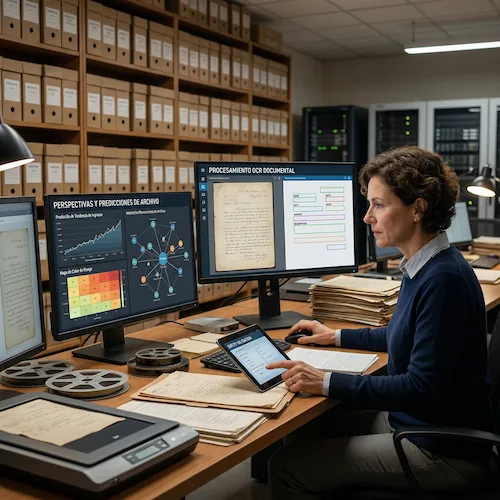
Invoices Contracts Forms Data extraction
Visual representation of intelligent document processing
Document AI Read, extract and validate information
04

AI assistants and enterprise knowledge

We build assistants connected to internal information to find, interpret and apply business knowledge, without making people search through scattered documents and systems.

Internal knowledge Semantic search RAG Assistants
Visual representation of AI assistants and enterprise knowledge
Assistants The right knowledge, when you need it
05

Custom AI integrations and systems

We integrate AI with ERPs, CRMs, APIs, databases and existing applications, or build the components needed when a process requires a tailored solution.

ERP / CRM APIs Databases Custom software
Visual representation of custom AI systems and integrations
Integrations AI connected to your systems, not isolated in a pilot

A single solution can combine several of these capabilities. We don’t sell one-size-fits-all packages: we design the architecture around your processes, expected impact and existing systems.

Tell us about your process →
From opportunity to production

Less guesswork. More evidence before scaling.

An AI project shouldn’t begin with months of development. We reduce uncertainty first: we understand the process, test what matters most and invest further only when the evidence shows it’s worthwhile.

Visual representation of AI solution analysis, validation, and implementation
Applied AI · from concept to operations
Our approach Test early. Integrate properly. Measure results.

AI delivers value when it passes three tests: it works technically, fits into day-to-day operations, and improves what matters.

01 Discover

Where is the real opportunity?

We assess the current process, its costs, dependencies, data, and bottlenecks. We don’t assume AI is the answer.

Outcome A clearly defined problem and opportunity.
02 Validate

Will it work with our data and constraints?

We test what carries the most uncertainty: models, data, rules, tools, and integrations. We set clear go/no-go criteria.

Outcome Proven feasibility before scaling.
03 Implement

How does it become part of daily operations?

We connect systems and define permissions, exceptions, traceability, security, and human oversight. Integration isn’t an afterthought: it’s part of the solution.

Outcome A solution ready for production.
04 Measure

Is it actually improving the process?

We track quality, usage, exceptions, and operational outcomes to decide what to refine, automate further, or scale. Every next step is based on evidence.

Outcome Measurable impact and informed improvements.
You don’t need a fully defined AI project to get started.

If you know which bottleneck, process, or problem you want to improve, we can help turn it into a concrete opportunity and decide how far it’s worth taking.

Tell us about your challenge →
AI built for real-world operations

More autonomy. Without losing control. The real test begins when AI moves beyond the demo.

When a solution accesses data, uses tools or takes action, getting the answer right is no longer enough. It must operate within clear boundaries and leave an audit trail of its actions.

01 Access

Define what it can see and what it can do.

We define data, tools, roles and permissions. An agent doesn’t need unrestricted access to be useful; it needs the right context for its task.

↳
Outcome Operational scope is clearly defined from the outset.
02 Guardrails

Not every action should run automatically.

We define when AI can proceed, when it must check conditions and when an exception calls for human judgment.

↳
Outcome Useful automation without turning every decision into a gamble.
03 Traceability

Know exactly what happened.

We log context, decisions, actions and the systems involved. When AI becomes part of daily operations, its behavior must be observable and auditable.

↳
Outcome Visibility into execution, not a black box.
04 Evolution

Measure before granting more autonomy.

We track errors, exceptions, costs and operational outcomes to decide what to automate further and what should remain under human supervision.


↳
Outcome Autonomy grows with evidence, not assumptions.
Operational AI governance 01 / 04
01 · Access Autonomy starts with clear boundaries.
Human-in-the-loop when needed
The goal isn’t to limit AI. It’s to let it take on more responsibility safely.

We design safeguards alongside automation, so the solution can scale without losing visibility into data, decisions, actions and exceptions.

Let’s talk about your process →
Real-world impact · AI & automation

Less manual work. More control where it counts.

AI delivers value when it becomes part of real business processes. It is not about automating for its own sake. It is about freeing teams from repetitive checks so they can focus on decisions that need human judgment.

Client case · Fundación Quiero Trabajo

From checking every invoice to handling only exceptions.

The foundation managed invoices and payments across emails, folders, and spreadsheets. We designed a workflow that receives documents, extracts and validates their data, performs pre-payment checks, and reconciles bank transactions.

Before

Manual document reviews and checks scattered across multiple tools.

Now

The team handles exceptions, with information and statuses in one place.
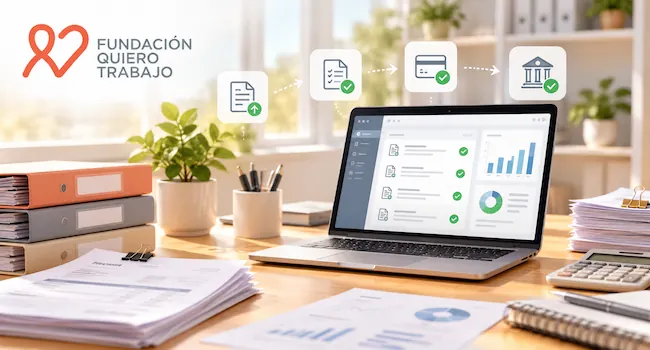
Fundación Quiero Trabajo: invoice automation and bank reconciliation project
What changes

Repetitive tasks are automated. Exceptions remain under human oversight.

Fewer manual checks

Document capture, data extraction, and validation in one workflow.

Connected reconciliation

Payments matched against transactions from multiple banks.

Better visibility and control

Issues are centralized so the team can focus on resolving them.

The next step

You don’t need to have AI figured out.

Start with what needs to work better.

Tell us where work gets stuck, which tasks still rely too heavily on manual effort, or which processes you want to scale. We’ll help you assess whether AI can add value, which approach makes sense, and how much investment is justified.

Explore our projects and case studies
No one-size-fits-all packages No need to start with a large project From opportunity to production

Let’s talk about your process

Tell us what you want to improve

Briefly describe your situation. We’ll get back to you to learn more.

Contact Form eng